
50 Strange Questions About the Unknown

There is a specific kind of chill that sets in not from a jump scare, but from a thought—a “glitch” in your logic that makes the walls of reality feel a little thinner. We spend our lives operating on the assumption that we understand the rules of the universe, but the more we look at the fringes of science and consciousness, the more those rules seem like mere suggestions.

This Valentine’s Day, instead of focusing on the known heart, let’s look into the heart of the mystery. Here are 50 strange questions about the unknown that will keep you up long after the lights go out.


The Nature of Reality: Are We Home?

If the universe is as vast as we believe, the odds that we are seeing the “raw” version of it are surprisingly low.

  1. Is the universe a simulation? If a civilization can eventually simulate a universe, how do we know we aren’t the millionth sub-simulation?
  2. What is the Mandela Effect? Is it just mass misremembering, or are we sliding between slightly different parallel timelines?
  3. Why is the “Goldilocks Zone” so perfect? Is the universe “fine-tuned” for life, or is that just survivor bias?
  4. Are we the “brains in a vat”? If your brain interprets electrical signals as reality, could those signals be artificially fed to you?
  5. Do colors look the same to everyone? Is your “red” my “blue,” and we just lack the language to realize it?
  6. Is math discovered or invented? Does the universe run on a code that exists independently of us?
  7. What happened before the Big Bang? Can “nothing” truly exist, or is the universe a closed loop with no beginning?
  8. Why does the observer effect change reality? In quantum physics, why does the act of looking at a particle change its behavior?
  9. Are we living in a hologram? Is all the 3D information of the universe actually stored on a 2D surface at the edge of space?
  10. Is “now” an illusion? If time is a dimension, does the past and future exist simultaneously like a static map?

Consciousness: The Final Frontier

We know how the brain works, but we still have no idea how “you” work. Where does the ghost live in the machine?

  1. Where do dreams go? Are they just firing neurons, or is the mind accessing a different plane of data?
  2. Is there a collective unconscious? Why do different cultures, separated by oceans, share the exact same archetypes and monster myths?
  3. Can two people share a thought? Is “telepathy” just high-level pattern recognition or a literal frequency?
  4. What is a “gut feeling”? Is it your subconscious processing data faster than your conscious mind, or something more “tuned in”?
  5. Does consciousness require a body? Could a cloud of gas or a complex machine possess a “soul”?
  6. Why do we experience déjà vu? Is it a neurological lag, or a memory of a path we’ve already walked?
  7. Where does “I” end and the world begin? At what point does the air you breathe become part of your “self”?
  8. Can thoughts influence matter? Does the “Global Consciousness Project” suggest our collective moods affect random number generators?
  9. What happens during a “flow state”? Why does time disappear when we are deeply focused?
  10. Is free will an illusion? If every action has a cause, are your “choices” just the inevitable result of chemical reactions?

To dive deeper into the science of the mind and reality, check out the latest theories on Scientific American.


Time & Space: Glitches in the Grid

We perceive time as an arrow, but the universe might see it as a tangled web.

  1. Is time travel possible through “glitches”? Are people who “vanish” simply slipping through thin spots in spacetime?
  2. Are there parallel versions of us? Every time you make a choice, does the universe split to accommodate the other option?
  3. Why do some places feel “heavy”? Can intense emotional events leave a “residual haunting” on the physical environment?
  4. Is the “Shadow Realm” just a higher dimension? Are “shadow people” just 4D beings passing through our 3D slice of world?
  5. Can we remember the future? What are “precognitive dreams” if the events haven’t happened yet?
  6. What is at the bottom of a Black Hole? Is it a singularity, or a back door to another universe?
  7. Do we all experience time at the same speed? Why does a minute on a clock feel different than a minute in a crisis?
  8. Is the “speed of light” a hardware limit? Is it the maximum speed of the “simulation” we live in?
  9. What are “Time Slips”? How do people occasionally find themselves walking through a street that hasn’t existed for a century?
  10. If the universe is expanding, what is it expanding into?

The Afterlife: The Great Transition

Energy cannot be created or destroyed, only transformed. So, what happens to the electrical “you” when the heart stops?

  1. What happens to “energy” after death? Does the bio-electric field of the human body simply dissipate, or does it retain its “shape”?
  2. Why do we feel “watched” in empty rooms? Is it an evolutionary predator-response or a sensing of something we can’t see?
  3. Are ghosts just “recordings”? Is hauntology just a playback of energy stored in stone and water?
  4. What is the “Silver Cord”? Many who experience out-of-body travel report a tether; what is it made of?
  5. Why do NDEs share a common “Tunnel”? Is it a biological shutdown sequence or a literal doorway?
  6. Do animals have souls? If consciousness is a spectrum, where do we draw the line for an afterlife?
  7. Is “Hell” just a state of mind? Could the afterlife be a manifestation of our own subconscious expectations?
  8. Can the dead communicate through technology? Why do spirits seem to prefer white noise and radio frequencies?
  9. Is reincarnation a cycle or a choice? Do we return to “learn lessons,” or are we caught in a cosmic loop?
  10. What is the “21 Grams” theory? Is there truly a measurable weight loss at the moment of death?

The Fringe: The Truly Weird

  1. Why do we all see the “Hat Man”? Why do people across the globe see the same specific entity during sleep paralysis?
  2. Is the moon artificial? Why is it the perfect size and distance to perfectly eclipse the sun?
  3. What are “Black Eyed Kids” asking for? Why is the “permission to enter” such a consistent theme in paranormal encounters?
  4. Are “Cryptids” interdimensional? Does Bigfoot vanish because he’s a physical animal, or because he’s stepping “sideways”?
  5. What is the “Wow! Signal” actually saying? Was it a greeting, a warning, or a cosmic accidental “pocket dial”?
  6. Is “luck” a measurable force? Why do some people seem to have a statistical defiance of probability?
  7. Why do we have “phantom limb” sensations? Is the “map” of our body stored somewhere other than the physical brain?
  8. Could an ancient civilization have been more advanced than us? Are we a species with amnesia?
  9. Are aliens just us from the future? Are “Greys” what humans look like after millions of years of evolution and space travel?
  10. If you find the answer to everything, will the universe let you stay?

From the depths of the Scottish Highlands to the silent vacuum of deep space, these mysteries linger in the collective psyche. For a deeper look into these mysteries, you can explore the full catalog of 50 unexplained phenomena people still talk about to see how these legends have evolved.

For those looking for the philosophical roots of these “creepy” shower thoughts, The Stanford Encyclopedia of Philosophy offers deep dives into the nature of consciousness and time.

50 Small Habits That Influence Daily Life

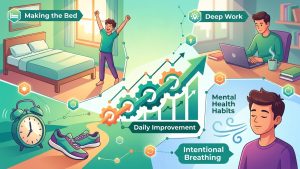
The trajectory of a successful life is rarely determined by massive, singular events. Instead, it is the product of “Atomic Habits”—small, incremental behaviors that, when compounded over time, lead to remarkable results. This philosophy suggests that if you can improve by just 1% each day, the mathematical result is a 37-fold improvement by the end of a year.

By focusing on the systems of daily life rather than just the goals, we can reshape our personal and social landscapes. Below are fifty small habits categorized by their impact on your rituals, relationships, finances, and mental well-being.


Morning Rituals: Setting the Foundation

How you spend the first hour of your day often dictates the energy of the remaining fifteen.

  • Making the Bed: This provides a small sense of pride and encourages you to do another task, and another.
  • Hydration First: Drinking 16 ounces of water immediately upon waking jumpstarts your metabolism.
  • “Deep Work” Windows: Dedicate the first 90 minutes of your workday to your most cognitively demanding task before checking email.
  • Sunlight Exposure: Ten minutes of natural light in the morning regulates your circadian rhythm.
  • The “One Big Thing” Rule: Identify the single most important task for the day to avoid the paralysis of a long to-do list.
  • Cold Exposure: A 30-second cold burst at the end of your shower can improve circulation and mental alertness.
  • Digital Fasting: Avoid checking social media until you have been awake for at least one hour.
  • Stretching: Five minutes of dynamic stretching helps wake up the nervous system.
  • Voice Affirmation: Stating your primary intention for the day out loud reinforces commitment.
  • Uniforming: Reducing wardrobe choices saves precious “decision capital” for later in the day.

Interpersonal Habits: The Social Compound Interest

Success is rarely a solo endeavor. The small ways we interact with others determine the strength of our social capital.

  • Remembering Names: Using a person’s name twice in the first minute of meeting them helps lock it into long-term memory.
  • Specific Gratitude: Instead of a general “thanks,” say, “Thank you for taking the time to explain that report; it helped me immensely.”
  • The “Wait to Speak” Audit: Practice active listening by waiting two seconds after someone finishes talking before you respond.
  • Eye Contact in Transit: Making brief, friendly eye contact with service workers or colleagues in the hallway builds a sense of community.
  • Handwritten Notes: In a digital world, a physical “thank you” note carries immense weight and memorability.
  • The “five-minute favor”: If you can do something for someone that takes less than five minutes, do it immediately without expecting a return.
  • Punctuality as Respect: Viewing being on time as a form of respect for the other person’s life.
  • Ask for Advice, Not Opinions: People feel more invested in your success when you ask for their guidance.
  • Celebrate Small Wins of Others: Being the first to congratulate a colleague on a minor achievement builds deep loyalty.
  • Put the Phone Away: Keeping your phone off the table during meals signals that the person in front of you is the priority.

As documented in the New York Times exploration of the power of tiny habits, the key to sustainability is starting so small that it is impossible to fail.


Financial Habits: Reclaiming Your Future

Financial freedom is less about how much you earn and more about the habits governing how you spend and save.

  • The “24-Hour Rule”: For any non-essential purchase over $50, wait 24 hours before hitting “buy.”
  • Automated Savings: Treat your savings like a bill that must be paid first every month.
  • Rounding Up: Use apps that round up your spare change to the nearest dollar and invest it.
  • Subscription Audit: Once a month, review your bank statement and cancel one service you no longer use.
  • The “Daily Coffee” Equivalent: Calculate the yearly cost of small daily luxuries to understand their true impact on your long-term goals.
  • Cash for Impulse Buys: If you want to buy something unplanned, use physical cash; the “pain of paying” is higher with paper than with plastic.
  • Visual Progress: Keep a chart of your debt or savings progress where you can see it daily.
  • Value-Based Spending: Ask yourself, “Does this purchase align with my long-term values?”
  • Packing Lunch: A classic habit that can save thousands of dollars and improve health simultaneously.
  • Emergency Fund Cushion: Maintaining a $1,000 “starter” fund to prevent small emergencies from becoming high-interest debt.

Mental Health Habits: Protecting the Inner Landscape

Our internal dialogue and physiological state are the filters through which we experience the world.

  • Intentional Breathing: Three deep diaphragmatic breaths can reset the sympathetic nervous system during a stressful moment.
  • The “Five-Minute Journal”: List three things you are grateful for and one thing that would make the day great.
  • Nature Breaks: A ten-minute walk in a park or green space reduces cortisol levels significantly.
  • Monotasking: Combat the myth of multitasking by focusing on one browser tab or one conversation at a time.
  • Evening Brain Dump: Write down everything on your mind before bed to prevent “rumination insomnia.”
  • Media Diet: Unfollow accounts that trigger feelings of inadequacy or “FOMO.”
  • Positive Reframing: Change “I have to” to “I get to” (e.g., “I get to go to the gym”).
  • Box Breathing: A 4-count inhale, 4-count hold, 4-count exhale, 4-count hold—used by Navy SEALs to maintain calm.
  • The “No” Muscle: Practice saying no to small commitments that don’t align with your current season of life.
  • Forgiveness of Self: Briefly acknowledging a mistake, learning the lesson, and moving on without self-flagellation.

According to research shared by Harvard Health on the benefits of mindfulness, even short bursts of intentional breathing can have a profound effect on managing daily anxiety.


The Compounding Effect of Small Actions

  1. Taking the Stairs: Physical health is built in the small choices between floors.
  2. Reviewing Your Why: Spending 60 seconds looking at a photo of your family or your goal board.
  3. Cleaning One Surface: If you feel overwhelmed, clean just the kitchen table or your desk.
  4. Active Commuting: Parking further away or getting off one bus stop early.
  5. Pre-Planning Outfits: Reducing “decision fatigue” in the morning by preparing the night before.
  6. Evening Reflection: Asking, “What went well today?” before falling asleep.
  7. The Two-Minute Rule: If a task takes less than two minutes (like taking out the trash), do it now.
  8. Digital Declutter: Deleting five unused apps or blurry photos every Sunday.
  9. Reading 10 Pages: This adds up to roughly 12 books a year.
  10. The Smile Habit: Smiling at yourself in the mirror can trigger a minor release of dopamine to start the day.

Conclusion

The beauty of the “Atomic Habits” approach is that it removes the pressure of perfection. You do not need to overhaul your entire life by Monday. By selecting just three habits from this list and implementing them consistently, you begin to rewrite your identity. Over time, these small behaviors stop being things you do and become part of who you are.…

50 Simple Physics Concepts Explained Clearly

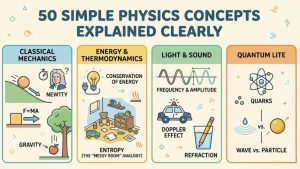
Physics often suffers from a branding problem—it uses intimidating words to describe very intuitive things. By using analogies, we can peel back the layers of jargon to reveal the simple logic underneath.

Here is a deep-dive glossary of 50 core concepts, categorized to help you master the fundamentals of the physical universe.


1. Classical Mechanics: The Rules of the Game

Classical mechanics describes how objects move. Think of this as the “instruction manual” for everything larger than an atom and slower than the speed of light.

  • Gravity: The universe’s “magnetic” pull. Every object with mass pulls on every other object.
  • Force: A push or a pull. Without force, nothing changes.
  • Inertia: The universe’s laziness. Objects want to keep doing exactly what they are already doing (staying still or moving).
  • Mass vs. Weight: Mass is how much “stuff” you are made of; weight is how hard gravity is pulling on that stuff. You have the same mass on the Moon, but you weigh much less.
  • Acceleration: Not just speeding up, but any change in velocity (speeding up, slowing down, or turning).
  • Centripetal Force: The “string” that keeps an object moving in a circle, like a tetherball or the Moon orbiting Earth.
  • Friction: The “tax” paid when two surfaces rub together, converting motion into heat.
  • Potential Energy: Stored energy, like a stretched rubber band or a ball at the top of a hill.
  • Kinetic Energy: The energy of motion.
  • Work: In physics, “work” only happens if a force moves an object. Pushing a wall until you sweat isn’t “work” because the wall didn’t move!

2. Energy & Thermodynamics: The Universal Budget

Thermodynamics is the study of heat and energy. It dictates what is possible in our universe.

  • Conservation of Energy: Energy cannot be created or destroyed; it only changes forms.
  • Entropy (The “Messy Room” Analogy): The universe naturally moves toward disorder. Just as a bedroom doesn’t spontaneously tidy itself, energy tends to spread out and become less useful over time.
  • Conduction: Heat transfer by touch (like a spoon getting hot in coffee).
  • Convection: Heat transfer through fluids (like hot air rising).
  • Radiation: Heat transfer through empty space (like sunlight).
  • Absolute Zero: The coldest possible temperature (0% Kelvin), where all molecular motion stops.
  • Thermal Expansion: Why bridges have gaps—materials expand when they get hot and molecules vibrate more.
  • Specific Heat: How much “effort” it takes to heat something up. Water has high specific heat, which is why the ocean stays cool even on a hot day.
  • The First Law: You can’t get something for nothing (Energy is conserved).
  • The Second Law: You can’t even break even (Entropy always increases).

Deep Dive: For a comprehensive look at the laws governing heat, check out the Laws of Thermodynamicsat Britannica.


3. Light & Sound: The Waves of Reality

Both light and sound travel as waves, but they play by different rules.

  • Frequency: How often a wave passes by. High frequency sounds like a whistle; low frequency sounds like a bass drum.
  • Amplitude: The “height” of the wave. In sound, this is volume; in light, this is brightness.
  • The Doppler Effect: Why a siren changes pitch as it passes you. Waves get “bunched up” as the source moves toward you and “stretched out” as it moves away.
  • Refraction: The “broken pencil” trick. Light slows down and bends when it moves from air into water.
  • Reflection: Light bouncing off a surface at the same angle it hit.
  • Diffraction: Waves bending around corners or squeezing through small gaps.
  • The Electromagnetic Spectrum: The full range of light, most of which we can’t see (X-rays, Microwaves, Radio).
  • Photons: Tiny “packets” of light energy.
  • Speed of Sound: Roughly 343 meters per second in air.
  • Speed of Light: The universal speed limit—roughly 300,000 kilometers per second.

4. Quantum Lite: The Weird Stuff

At the very smallest scale, the rules of classical mechanics break down completely.

  • Quarks: The “Legos” of the universe. They make up protons and neutrons.
  • Wave-Particle Duality: The idea that light and electrons act like both solid little balls (particles) and ripples in a pond (waves).
  • Superposition: An object existing in multiple states at once until someone looks at it (Schrödinger’s Cat).
  • Quantum Entanglement: “Spooky action at a distance.” Two particles becoming linked so that what happens to one instantly affects the other, no matter the distance.
  • Uncertainty Principle: The rule that you can’t know exactly where a particle is and how fast it’s going at the same time.
  • Standard Model: The “periodic table” for subatomic particles.

5. 10 Bonus Concepts to Round Out the 50

  1. Magnetism: Caused by the alignment of electron spins.
  2. Electricity: The flow of electrons through a conductor.
  3. Resistance: How much a material “fights” the flow of electricity.
  4. Buoyancy: The upward force that keeps boats afloat.
  5. Pressure: Force spread over an area.
  6. Density: How tightly packed the “stuff” in an object is.
  7. Plasma: The fourth state of matter—ionized gas found in stars and lightning.
  8. Surface Tension: The “skin” on top of water that lets bugs walk on it.
  9. Half-Life: The time it takes for half of a radioactive substance to decay.
  10. Relativity: The fact that time and space are linked and can stretch or shrink depending on speed and gravity.

Why does this matter?

Understanding these concepts doesn’t just make you better at trivia; it changes how you see the world especially in real life. When you look at a rainbow, you aren’t just seeing colors—you’re seeing the dispersion of light. When you feel the pull of a car turn, you’re experiencing inertia. You aren’t just living in the world; you are part of a giant, logical, physical machine.…

50 Unexplained Phenomena People Still Talk About

The world is a far stranger place than our textbooks suggest. Despite our leaps in technology and the ubiquity of high-definition cameras in every pocket, there remain corners of our existence that defy logic, physics, and reason. From the depths of the Scottish Highlands to the silent vacuum of deep space, these mysteries linger in the collective psyche.

In the spirit of All Hallows’ Eve, we have cataloged the world’s most enduring mysteries—50 phenomena that remind us that “truth” is often a moving target.


Classic Cryptids: The Monsters Among Us

While biology attempts to categorize every living thing, “cryptids” represent the animals that science refuses to acknowledge, yet witnesses refuse to forget.

  1. Bigfoot (Sasquatch): The towering, bipedal primate of the Pacific Northwest. Despite thousands of footprints and the famous Patterson-Gimlin film, no physical remains have ever been recovered.
  2. The Loch Ness Monster: “Nessie” remains the crown jewel of lake monsters. Is it a surviving plesiosaur or just a very large eel?
  3. The Mothman: A winged humanoid with glowing red eyes that terrorized Point Pleasant, West Virginia, in the 1960s.
  4. The Chupacabra: The “goat-sucker” of Puerto Rico and Mexico, described as a reptilian creature with spines.
  5. The Jersey Devil: A winged, hooved beast said to inhabit the Pine Barrens of New Jersey.
  6. The Kraken: Once a sailor’s myth, now partially validated by the discovery of the Giant Squid—though the legends describe something much larger.
  7. The Yeti: The “Abominable Snowman” of the Himalayas.
  8. The Beast of Bray Road: A werewolf-like creature reported in Wisconsin.
  9. The Dover Demon: A small, large-eyed humanoid sighted over 48 hours in Massachusetts.
  10. The Flatwoods Monster: A ten-foot-tall entity sighted after a bright object crashed in West Virginia in 1952.

Historical Mysteries: Lost at Sea and Frozen in Time

Sometimes, the mystery isn’t a monster, but the chilling circumstances humans leave behind. These cases remain the ultimate “cold cases” of history.

  1. The Mary Celeste: In 1872, this brigantine was found adrift in the Atlantic. The crew was gone, but their belongings and a six-month supply of food were untouched.
  2. The Dyatlov Pass Incident: In 1959, nine hikers died in the Ural Mountains under horrific, inexplicable circumstances—including internal trauma without external bruising and traces of radiation.
  3. The Lost Colony of Roanoke: An entire English settlement vanished in 1590, leaving only the word “Croatoan” carved into a tree.
  4. The Voynich Manuscript: An illustrated codex hand-written in an unknown writing system that has baffled the world’s top cryptographers for centuries.
  5. The Dancing Plague of 1518: Hundreds of people in Strasbourg danced for days without rest, some literally dying of exhaustion.
  6. The Ourang Medan: A ghost ship story where the entire crew was found dead with expressions of sheer terror, shortly before the ship exploded.
  7. The Beale Ciphers: A set of three ciphertexts that supposedly reveal the location of buried gold worth over $43 million.
  8. The Antikythera Mechanism: An ancient Greek analog computer so advanced it shouldn’t have existed for another 1,000 years.
  9. The Sodder Children Disappearance: Following a house fire in 1945, five children vanished without a trace of skeletal remains in the ashes.
  10. The Oak Island Money Pit: A legendary treasure site that has claimed lives and millions of dollars in excavation costs with no clear answer.

Ufology: Visitors from Above

The question is no longer just “Are we alone?” but “What are they doing here?” Ufology has moved from the fringe to the halls of Congress.

  1. The Phoenix Lights: In 1997, thousands of people witnessed a massive, V-shaped craft gliding silently over Arizona.
  2. The “Tic-Tac” UFOs: Encountered by Navy pilots from the USS Nimitz, these objects displayed flight characteristics that defy the laws of inertia.
  3. The Wow! Signal: A strong narrowband radio signal detected by the Big Ear radio telescope in 1977. It bore the hallmarks of extraterrestrial origin.
  4. The Roswell Incident: The 1947 crash that birthed the modern UFO era.
  5. The Rendlesham Forest Incident: Often called “Britain’s Roswell,” involving multiple military witnesses and physical craft sightings.
  6. The Black Knight Satellite: A mysterious object in polar orbit that some believe is a 13,000-year-old alien satellite.
  7. The Betty and Barney Hill Abduction: The first widely publicized alien abduction account in the US.
  8. Crop Circles: While many are hoaxes, the complexity and “bent node” cellular changes in the stalks of some circles remain unexplained.
  9. The Lubbock Lights: A V-shaped formation of lights seen over Texas in 1951, captured in famous photographs.
  10. Fast Radio Bursts (FRBs): Millisecond-long bursts of radio waves from deep space that repeat in patterns scientists still can’t fully explain.

For more on the declassified history of these sightings, you can explore the National Archives’ UFO records.


The Supernatural: The Thin Veil

The paranormal isn’t just about what we see in the sky or the woods; it’s about what we feel in our own homes and at the edge of life itself.

  1. Poltergeists: Unlike traditional ghosts, these “noisy spirits” are associated with physical disturbances, like moving furniture or spontaneous fires.
  2. Shadow People: Dark, human-shaped silhouettes seen in the periphery of vision, often reported during sleep paralysis.
  3. Near-Death Experiences (NDEs): Consistent accounts of “white lights” and out-of-body experiences reported by people clinically dead.
  4. The Enfield Haunting: A famous 1970s case of alleged poltergeist activity in a London suburb.
  5. The Black-Eyed Children: An urban legend involving hitchhikers or panhandlers with entirely black eyes who evoke a sense of primordial dread.
  6. Electronic Voice Phenomena (EVP): Voices found on digital recordings that weren’t audible at the time of recording.
  7. Reincarnation Cases: Documented instances of children remembering specific, verifiable details about lives they couldn’t have known about.
  8. The Brown Mountain Lights: Ghostly orbs that have appeared over a North Carolina ridge for over a century.
  9. The Bell Witch: A famous 19th-century haunting in Tennessee that allegedly resulted in the death of a man.
  10. The Doppelgänger: Seeing an exact double of oneself, often considered an omen of bad luck or death.

The Fringe: Reality Glitches and Oddities

  1. The Hum: A low-frequency persistent sound heard in various parts of the world, like Taos, New Mexico.
  2. Spontaneous Human Combustion: Cases where bodies burn almost entirely to ash without igniting the surrounding furniture.
  3. The Mandela Effect: Large groups of people remembering history differently (e.g., the Berenstain Bears).
  4. The Overtoun Bridge: A bridge in Scotland where hundreds of dogs have inexplicably leaped to their deaths.
  5. The Hessdalen Lights: Unusual lights in Norway that appear to “hover” and display strange spectra.
  6. Ball Lightning: A rare atmospheric phenomenon involving glowing, spherical objects during thunderstorms.
  7. The Paulding Light: A mysterious light in Michigan that has been the subject of local lore for decades.
  8. Skyquakes: Loud booming sounds coming from the sky with no obvious meteorological or seismic cause.
  9. The Green Children of Woolpit: Two children who allegedly appeared in a 12th-century English village with green skin and speaking an unknown language.
  10. The Devil’s Footprints: In 1855, a trail of hoof-like marks appeared in the snow overnight in Devon, England, covering over 40 miles in a straight line.

While skeptics argue that every mystery has a rational explanation, the persistence of these stories suggests that we are still far from understanding the true nature of our reality. As the Smithsonian Magazine often explores, our fascination with the unexplained is a core part of the human experience—a bridge between the known and the infinite unknown.…

50 Social Behaviors That Shape First Impressions

In the time it takes to blink, a stranger has already decided whether you are trustworthy, competent, and likable. This isn’t a conscious deliberation; it is a biological imperative. Psychologists call this “thin-slicing”—the ability of our minds to find patterns in events based only on “thin slices” of experience.

Research suggests that we form these judgments within the first seven seconds of an encounter. While we like to believe we are rational observers, our brains are hardwired for efficiency over accuracy. Understanding the fifty social behaviors that drive these snap judgments allows us to navigate social and professional landscapes with greater intentionality.

The Science of the “Thin-Slice” Judgment

The concept of thin-slicing was popularized by social psychologists like Nalini Ambady and Robert Rosenthal. Their research demonstrated that observers could predict a teacher’s end-of-semester evaluations or a doctor’s likelihood of being sued for malpractice based on video clips lasting less than thirty seconds. These judgments are rooted in our evolutionary past, where the ability to quickly distinguish a friend from a foe was a survival mechanism.

Today, those same instincts are applied to job interviews, first dates, and networking events. As noted in research highlighted by Psychology Today regarding the science of first impressions, these initial assessments are remarkably durable, often influencing how people interpret your future actions for months or even years. By mastering the non-verbal and verbal cues below, you can ensure that the “thin slice” you provide is a true reflection of your character.

Non-Verbal Cues: The Silent Language

Before you speak a single word, your body is communicating. These non-verbal signals often carry more weight than the actual content of your conversation.

  1. The “Micro-Smile”: A fleeting, genuine smile that reaches the eyes (the Duchenne smile) signals warmth and reduces the perceived threat.
  2. Posture Symmetry: Standing straight but not rigid conveys confidence. Slumping suggests a lack of energy or low self-esteem.
  3. Eye Contact Duration: Maintaining eye contact for roughly 60-70% of the conversation strikes the balance between being attentive and being aggressive.
  4. The Handshake Pressure: A firm (not crushing) handshake is still a universal symbol of reliability and professionalism.
  5. Open Palms: Gesturing with open palms suggests honesty and transparency.
  6. Head Tilting: A slight tilt of the head while listening indicates empathy and curiosity.
  7. Proximity Management: Respecting personal space—usually 1.5 to 4 feet in social settings—shows social awareness.
  8. Mirroring: Subtly mimicking the posture or gestures of the person you are talking to builds subconscious rapport.
  9. Feet Direction: Pointing your feet toward the person you are speaking with indicates full engagement.
  10. The “Eyebrow Flash”: A momentary lift of the eyebrows upon meeting someone is a universal sign of recognition and friendliness.
  11. Fidgeting Control: Avoiding hair-twirling or pen-clicking prevents you from appearing anxious or bored.
  12. The Power Lean: Slightly leaning in shows interest; leaning too far back can seem dismissive.

Communication Styles: Beyond the Words

The way you structure your speech and the way you listen are the two pillars of a strong first impression. In high-stakes environments, these habits are critical; for instance, Harvard Business Review emphasizes that projecting warmth is the necessary precursor to projecting competence, as people need to trust you before they care how smart you are.

  1. Active Listening: This involves nodding and providing brief verbal affirmations like “I see” or “That makes sense.”
  2. Waiting to Speak vs. Listening: Many people simply wait for their turn to talk. True listening involves processing the information before formulating a response.
  3. Tone of Voice: A lower, resonant pitch is often associated with authority and calm, whereas a high-pitched “up-talk” at the end of sentences can sound uncertain.
  4. The Three-Second Pause: Pausing before you answer a question makes you appear thoughtful and deliberate.
  5. Using Names: Repeating a person’s name shortly after being introduced anchors the memory and makes the interaction feel personal.
  6. Eliminating Fillers: Reducing “um,” “uh,” and “like” increases your perceived intelligence and preparedness.
  7. Specific Compliments: Complimenting a specific achievement rather than a general trait shows you are paying attention.
  8. Humor Calibration: Using self-deprecating humor (in moderation) can make you more relatable and approachable.
  9. Asking “How” and “Why”: Open-ended questions keep the conversation flowing and show genuine interest.
  10. Emotional Matching: If someone is sharing a serious story, matching their gravity—rather than trying to “lighten the mood” too quickly—builds trust.
  11. The “Wait” Rule: Never interrupting is perhaps the fastest way to be labeled a “great conversationalist.”

Punctuality & Reliability: The Respect Factor

In a world where everyone is busy, how you manage time serves as a proxy for your integrity.

  1. The Five-Minute Rule: Being five minutes early is on time. Being “on time” is often perceived as being late.
  2. Digital Punctuality: Joining a Zoom call exactly at the start time shows technical proficiency and respect for the host’s schedule.
  3. The “Heads Up” Text: If you are going to be late, a text sent 20 minutes prior is professional; a text sent at the time you were supposed to arrive is an excuse.
  4. Follow-Through on Small Promises: If you say “I’ll send you that link,” sending it within an hour establishes you as a person of action.
  5. Consistency: Showing up with the same level of energy and temperament every time builds a “brand” of reliability.

Digital First Impressions: The New Frontier

In the modern age, your first impression often happens before you ever meet in person.

  1. Email Etiquette: A clear, concise subject line and a lack of typos signal a disciplined mind.
  2. Social Media “Vibes”: Your LinkedIn profile photo and the tone of your posts create a digital “aura” that recruiters and peers check instantly.
  3. Response Time: While you shouldn’t be a slave to your inbox, responding within 24 hours suggests that you are organized and attentive.
  4. The Professional Avatar: Using a high-quality, friendly headshot across platforms ensures a cohesive identity.

Environmental and Behavioral Nuances

  1. Cleanliness of Personal Space: Whether it’s your car or your desk, your environment is an extension of your mental state.
  2. Attire Choice: Dressing slightly “above” the occasion shows you value the event and the people attending.
  3. Handling Mistakes: Admitting a small error immediately (like mispronouncing a name) shows high emotional intelligence.
  4. Phone Etiquette: Keeping your phone face down or in your pocket during a meal is the ultimate sign of respect.
  5. Giving Credit: Mentioning others’ contributions during your first conversation shows you are a team player.
  6. The “Exit Strategy”: Ending a conversation gracefully (“It was great meeting you, I’m going to go grab some food”) leaves a lasting positive memory.
  7. Generosity of Information: Sharing a helpful tip or contact without being asked establishes you as a “giver.”
  8. Calm Under Pressure: How you react when a waiter messes up an order or technology fails tells a stranger everything about your temperament.
  9. Posture Consistency: Staying engaged even when you aren’t the one speaking.
  10. The Handshake Contact: Ensuring palm-to-palm contact for sincerity.
  11. Scent Management: Subtle fragrance is a memory trigger; overpowering scents are a distraction.
  12. Grooming Details: Polished shoes or ironed shirts suggest attention to detail.
  13. Appropriate Self-Disclosure: Sharing just enough to be human, but not so much that it’s uncomfortable.
  14. Complimenting the Host: Recognizing the effort behind an event.
  15. Mindful Nodding: Not “bobble-heading,” but rhythmic nodding to show comprehension.
  16. Resourcefulness: Offering to help solve a minor problem (like finding a chair) in real-time.
  17. Validating Opinions: Even if you disagree, acknowledging their perspective before stating yours.
  18. The Final Smile: Leaving the interaction with the same warmth you started with.

Conclusion

The psychology of the “thin-slice” isn’t about being “fake”; it is about being mindful. By mastering these 50 behaviors, you remove the “noise” that prevents people from seeing your true character. When your non-verbal cues, communication style, and digital presence align, you create a first impression that is not only positive but also authentic.…

50 Everyday Examples of Physics in Real Life

Physics is often tucked away in heavy textbooks and complex equations, but it isn’t just a subject for academics in lab coats. It is the invisible set of rules that governs every second of our lives. From the moment your alarm clock rings to the second you rest your head on a pillow, you are interacting with the fundamental laws of the universe.

By bridging the gap between “textbook physics” and the physical world, we can begin to see the beauty in the mundane. Here are 50 examples of physics in action across four key areas of your daily routine.


1. The Physics of the Kitchen

The kitchen is essentially a laboratory where thermodynamics and fluid mechanics take center stage.

  • Microwave Ovens: These use “dielectric heating.” Microwaves strike water molecules in food, causing them to rotate rapidly. This molecular friction creates heat.
  • Pressure Cookers: By increasing the atmospheric pressure inside the pot, the boiling point of water rises. This allows food to cook at much higher temperatures than 100°C, saving time.
  • Induction Hobs: These use electromagnetism to heat the pan directly, rather than using a flame or electric coil to transfer heat.
  • Toasters: Infrared radiation is used to brown your bread.
  • Boiling Water: A classic example of a phase transition and convection currents.
  • Refrigeration: This relies on the Second Law of Thermodynamics; heat is pumped from a cool area to a warmer one using a refrigerant.
  • Knife Sharpening: This is about pressure ($P = F/A$). By making the edge of the knife thinner (reducing area), you increase the pressure applied for the same amount of force.
  • Steam from a Kettle: Evaporation and condensation in real-time.
  • Salt in Water: Boiling point elevation—adding salt slightly raises the temperature at which water boils.
  • Whisking Eggs: Mechanical energy being converted into structural changes in proteins.

2. Physics in Motion

Every time you move, you are a living demonstration of Newton’s Laws.

  • Walking (Friction): You can walk because of the friction between your shoes and the floor. On ice, the friction coefficient is low, which is why you slip.
  • Driving (Inertia): When a car stops suddenly, your body wants to keep moving forward. This is Newton’s First Law: an object in motion stays in motion.
  • Seatbelts (Momentum): Seatbelts are designed to increase the time it takes for your body to stop during a crash, which reduces the “impulse” or force felt by your body ($F = \Delta p / \Delta t$).
  • Bicycling: Gyroscopic stability helps keep the bike upright while you are moving.
  • Car Brakes: They convert kinetic energy into thermal energy through friction.
  • Walking up Stairs: You are performing “work” against the force of gravity.
  • Opening a Door: This is an example of torque. The further you are from the hinge, the easier it is to push.
  • Ball Games: When you kick a soccer ball, you are dealing with aerodynamics and the Magnus effect if the ball curves.
  • Ice Skating: The pressure of the blade melts a tiny layer of ice, allowing for near-frictionless gliding.
  • Elevators: You feel heavier as the elevator starts moving up because of upward acceleration adding to the force of gravity.

3. The Tech We Carry

The gadgets in your pocket are the result of centuries of breakthroughs in electromagnetism and quantum mechanics.

  • Smartphones (Electromagnetism): Your phone sends and receives information via radio waves, which are part of the electromagnetic spectrum.
  • GPS (Relativity): This is one of the coolest examples of physics. Because GPS satellites move fast and are further from Earth’s gravity, their clocks run differently than ours. Engineers must use Einstein’s Theory of Relativity to synchronize them, or your location would be off by kilometers!
  • Touchscreens: Most phones use “capacitive” screens. Since the human body conducts electricity, touching the screen alters the local electrostatic field.
  • Digital Cameras: These use the Photoelectric Effect, where light hitting a sensor is converted into electrical signals (photons to electrons).
  • Wi-Fi: Uses 2.4GHz or 5GHz radio frequencies to transmit data through walls.
  • Bluetooth: Short-range radio waves that hop between frequencies to avoid interference.
  • Noise-Canceling Headphones: These use “destructive interference.” They create a sound wave that is the exact opposite (out of phase) of the background noise to cancel it out.
  • Hard Drives: Utilize magnetism to store data in binary form (0s and 1s).
  • Battery Life: Chemical energy being converted into electrical energy.
  • LED Lights: Use semiconductors to produce light much more efficiently than incandescent bulbs.

4. Natural Wonders

The world around us is a constant light and sound show dictated by physics.

  • Why the Sky is Blue: This is due to Rayleigh scattering. Shorter (blue) wavelengths of sunlight are scattered in all directions by the gases in Earth’s atmosphere.
  • Rainbows: A combination of refraction, reflection, and dispersion of light inside water droplets.
  • Sunsets: As the sun gets lower, light has to travel through more atmosphere, scattering the blue light away and leaving the longer red wavelengths.
  • The Echo: Sound waves reflecting off a distant surface and returning to your ears.
  • Thunder and Lightning: The massive discharge of static electricity (lightning) creates a shockwave of expanding air (thunder).
  • Ocean Tides: The gravitational pull of the moon (and to a lesser extent, the sun) on Earth’s oceans.
  • Mirages: Light rays bending (refracting) through layers of air with different temperatures.
  • Clouds: Water vapor condensing into tiny droplets when the air reaches its dew point.
  • Bubbles: Their spherical shape is caused by surface tension, which tries to minimize the surface area for a given volume.
  • The Northern Lights (Aurora Borealis): Charged particles from the sun colliding with Earth’s magnetic field and atmosphere.

Conclusion: 10 More Quick Hits

  • Pencils: Friction leaves graphite on the paper.
  • Soap: Reduces the surface tension of water to lift dirt.
  • Vacuum Cleaners: Create a low-pressure area so higher-pressure air rushes in, carrying dust.
  • Glasses/Contacts: Use lenses to refract light and focus it correctly on your retina.
  • Pendulum Clocks: Rely on the constant period of a swinging weight.
  • Umbrellas: Use tension and geometry to stay rigid against the wind.
  • Sticking a Magnet to a Fridge: Magnetic fields at work.
  • Streaming Video: Fiber optics use Total Internal Reflection to carry data as light.
  • Car Headlights: Use parabolic reflectors to beam light in a specific direction.
  • Sleeping: Even when still, gravity is exerting a constant 9.8 $m/s^2$ force, keeping you firmly on your mattress!

By recognizing these principles, the world transforms from a series of random events into a beautifully orchestrated symphony of physical laws as explained clearly here. Physics isn’t just in the classroom—it’s everywhere.…

50 Simple Cooking Tips for Everyday Meals

Cooking is often portrayed as a rigid discipline of measurements and timers, but the most successful home cooks treat it more like a series of small, manageable habits. Whether you are rushing to get dinner on the table after a long workday or hosting a weekend gathering, mastering the “invisible” mechanics of the kitchen can transform a stressful chore into a creative outlet.

The following 50 tips are designed to streamline your process, enhance the natural flavors of your ingredients, and give you the confidence to cook without constantly glancing at a recipe.


Phase 1: Preparation and Organization

Before the heat even touches the pan, the success of your meal is often decided on the cutting board.

  • 1. Sharp Knives are Safer: A dull blade requires more force, increasing the chance of a slip. Keep your tools honed.
  • 2. The “Claw” Grip: Always tuck your fingertips inward when chopping to avoid accidental nicks.
  • 3. Mise en Place: This French term simply means “everything in its place.” Prep all your vegetables and sauces before you turn on the stove.
  • 4. Room Temperature Meat: Take steak or chicken out of the fridge 20 minutes before cooking. This ensures even heat distribution.
  • 5. Stabilize Your Board: Place a damp paper towel under your cutting board to prevent it from sliding.
  • 6. Dry Your Proteins: Pat meat dry with a paper towel. Moisture creates steam, which prevents the beautiful brown crust (the Maillard reaction) from forming.
  • 7. Read the Whole Recipe: Never start cooking until you’ve read the instructions twice to avoid “surprise” overnight marinations.
  • 8. Use a Trash Bowl: Keep a large bowl on the counter for scraps. It saves you dozens of trips to the bin.
  • 9. Grate Your Own Cheese: Pre-shredded cheese is coated in potato starch to prevent clumping, which stops it from melting smoothly.
  • 10. Peel Garlic Easily: Crush the clove with the flat side of your knife to make the skin pop right off.

Phase 2: Heat, Fat, and Sizzle

Understanding how food reacts to heat is the difference between a soggy stir-fry and a professional-grade meal.

  • 11. Don’t Crowd the Pan: If there is too much food in the pan, the temperature drops and the food steams in its own juices instead of searing.
  • 12. Pre-heat Your Pan: You should hear a distinct hiss the moment food touches the surface.
  • 13. Choose the Right Oil: Use high-smoke point oils like avocado or canola for searing, and save extra virgin olive oil for low heat or finishing.
  • 14. The “Butter Finish”: Adding a cold knob of butter at the end of a sauce creation gives it a glossy, restaurant-style sheen.
  • 15. Don’t Flip Too Early: If meat is sticking to the pan, it’s not ready to be flipped. It will naturally release once a crust has formed.
  • 16. Toast Your Spices: Put whole spices in a dry pan for 30 seconds before grinding to release their essential oils.
  • 17. Bloom Your Tomato Paste: Fry tomato paste in oil for a minute until it turns dark brick-red to remove the “raw” metallic taste.
  • 18. Use a Meat Thermometer: Stop guessing. It is the only way to guarantee a juicy chicken breast every single time.
  • 19. Deglaze the Pan: After searing meat, pour in a little wine or broth to scrape up the “fond” (the brown bits). That is where the flavor lives.
  • 20. Let it Rest: Always let meat sit for 5-10 minutes after cooking. This allows the juices to redistribute rather than spilling out on the plate.

Phase 3: The Art of Seasoning

Salt is essential, but it is only one tool in your flavor arsenal.

  • 21. Salt in Layers: Season your vegetables while they sauté, not just at the very end.
  • 22. Acid is the Missing Link: If a dish tastes “flat” but you’ve already added salt, add a squeeze of lemon or a splash of vinegar.
  • 23. Use Kosher Salt: The larger grains allow for better control and even distribution compared to fine table salt.
  • 24. Season From Up High: Sprinkling salt from 10 inches above the food ensures an even coating rather than concentrated “salt pockets.”
  • 25. Fresh Herbs at the End: Soft herbs like parsley, cilantro, and basil should be added at the very end of cooking to preserve their color and bright flavor.
  • 26. Woodier Herbs Early: Rosemary and thyme need time to break down; add them early in the roasting or braising process.
  • 27. Save the Pasta Water: That starchy, salty liquid is “liquid gold” for emulsifying sauces and making them stick to your noodles.
  • 28. Balance Heat with Fat: If a dish is too spicy, add dairy (cream or yogurt) or a healthy fat like avocado to neutralize the burn.
  • 29. Sugar Balances Acid: If your tomato sauce is too tart, a tiny pinch of sugar can mellow it out.
  • 30. Taste as You Go: This is the most important rule. You cannot fix a dish once it is on the dinner table.

For a deeper look at the chemistry of flavor, Serious Eats provides incredible breakdowns on why certain techniques, like the Maillard reaction, are vital for home cooks.

Phase 4: Efficiency and Kitchen Hacks

Saving time doesn’t mean cutting corners; it means working smarter.

  • 31. Freeze Your Ginger: It lasts longer and is much easier to grate when frozen.
  • 32. Use a Microplane: This tool is perfect for zest, garlic, ginger, and hard cheeses.
  • 33. Clean as You Go: If you have 30 seconds while the onions sauté, wash the cutting board. You’ll thank yourself later.
  • 34. Store Flour in the Fridge: If you don’t use it often, keeping it cool prevents it from going rancid.
  • 35. Use Scissors for Herbs: Sometimes a pair of kitchen shears is faster and cleaner than a knife for chives or scallions.
  • 36. The “Spoon” Ginger Hack: Use the edge of a teaspoon to scrape the skin off ginger—it wastes much less flesh than a peeler.
  • 37. Reheat Pizza in a Skillet: Skip the microwave. A pan with a lid makes the crust crispy and melts the cheese perfectly.
  • 38. Soak Onions in Water: If raw onions are too sharp for your salad, soak slices in cold water for 10 minutes to take the “bite” out.
  • 39. Double the Batch: If you’re making lasagna or chili, double it and freeze half. It’s the same amount of cleanup for twice the food.
  • 40. Use an Eggshell to Catch Shells: If a piece of shell falls into the bowl, use a larger half-shell to scoop it out; they act like magnets.

Phase 5: Elevating the Everyday

Simple touches can turn a basic meal into something memorable.

  • 41. Warm Your Plates: Serving hot food on a cold plate is a common mistake. Run your plates under hot water or put them in a low oven for a minute.
  • 42. Contrast Textures: A soft dish (like creamy pasta) almost always benefits from something crunchy (like toasted breadcrumbs).
  • 43. Don’t Overmix: When making pancakes or muffins, lumps are fine. Overmixing develops gluten and makes them tough.
  • 44. Use Better Butter: For simple dishes like toast or radishes, high-quality European-style butter makes a noticeable difference.
  • 45. Roast Your Vegetables Hard: Don’t be afraid of a little char. It brings out the natural sugars in broccoli, carrots, and sprouts.
  • 46. Buy Whole Spices: They stay fresh significantly longer than pre-ground versions.
  • 47. Know Your Oven’s Hot Spots: Every oven has them. Rotate your baking sheets halfway through for an even bake.
  • 48. Blanch Green Veggies: Boil green beans or broccoli for 2 minutes, then plunge into ice water. They stay vibrant green instead of turning grey.
  • 49. Use a Slotted Spoon: It’s the best tool for removing fried items or poaching eggs without bringing unwanted liquid along.
  • 50. Trust Your Instincts: Recipes are guides, not laws. If you like more garlic, add more garlic.

Developing your palate is a journey that requires patience and experimentation. As noted by the culinary experts at Bon Appétit, the best way to improve is simply to keep cooking, making mistakes, and learning the “why” behind the “how.” With these 50 tips in your pocket, your next everyday meal is already on its way to being a success.…

50 Kitchen Habits That Improve Your Cooking

Most people believe that becoming a better cook requires mastering complex recipes or buying expensive gadgets. However, the true difference between a frustrated cook and a confident one lies in their habits. Professional chefs don’t just have better skills; they have better systems. By shifting your focus from the food itself to the way you move, think, and clean within the kitchen, you can drastically improve the quality of every meal you serve.

These 50 habits are designed to reduce kitchen friction, improve safety, and ensure that your final dish tastes exactly as you intended.


The Habit of Preparation: The “Mise en Place” Mindset

Before the stove is ever clicked on, the success of your meal is determined by your organizational habits.

  • 1. Read the Recipe Twice: Before touching an ingredient, read the entire recipe to identify time-sensitive steps.
  • 2. Clear the Decks: Start with a clean counter. Clutter leads to accidents and mental fog.
  • 3. Pre-Measure Everything: Don’t measure spices over a steaming pot; measure them into small bowls beforehand.
  • 4. Sharpness Check: Briefly hone your knife before every major prep session to ensure clean, effortless cuts.
  • 5. The “Flat Side” Rule: Always place the flat side of a vegetable (like a halved onion) down on the board to prevent rolling.
  • 6. Peel Into a Bowl: Keep a dedicated scrap bowl on your workspace to keep your cutting board clear of debris.
  • 7. Standardize Your Prep: Cut vegetables into uniform sizes so they cook at the same rate.
  • 8. Set Up a “Landing Zone”: Clear a space near the stove for hot pans or finished food to sit.
  • 9. Gather Your Tools: Ensure your spatulas, tongs, and tasting spoons are within arm’s reach before you start.
  • 10. Preheat Early: Give your oven and pans ample time to reach the correct temperature.

The Cleaning Habit: “Clean as You Go”

The most important habit in a professional kitchen isn’t about flavor—it’s about sanitation and workflow.

  • 11. Empty the Dishwasher First: Start your cooking session with an empty dishwasher so dirty tools can go straight inside.
  • 12. Wipe Spills Immediately: A spill that is wiped up instantly takes two seconds; a dried spill takes ten minutes of scrubbing.
  • 13. Soak Used Pots: As soon as a pot is emptied, fill it with soapy water to prevent food from hardening.
  • 14. Keep a “Damp and Dry” Towel: Have one damp towel for wiping surfaces and one dry towel for handling hot handles.
  • 15. Sanitize the Sink: Treat your sink as a workspace, not just a drain. Keep it clear of clutter.
  • 16. Clean Your Board Between Ingredients: Wipe your cutting board after finishing one vegetable type to keep flavors distinct.
  • 17. Organize the Fridge Weekly: A “First In, First Out” (FIFO) habit prevents food waste and ensures you use fresh ingredients.
  • 18. Sweep Regularly: A clean floor is a safe floor. Flour or oil on the ground is a slipping hazard.
  • 19. Store Labels and Tape: Develop the habit of labeling and dating leftovers immediately.
  • 20. The “Five-Minute Reset”: Once the food is in the oven, spend five minutes cleaning everything used for prep.

The Sensory Habit: Tasting and Adjusting

Cooking is a live performance. If you aren’t engaging your senses throughout the process, you are essentially cooking “blind.”

  • 21. Taste at Every Stage: Taste the sauce before and after adding salt to understand the impact.
  • 22. Smell the Aromatics: Learn to identify when garlic or onions are done by their scent rather than their color.
  • 23. Use Two Tasting Spoons: Dip one spoon into the pot, pour it onto the second spoon, and taste from that to maintain hygiene.
  • 24. Listen to the Sizzle: A quiet pan means the temperature is too low; a violent pop means it’s too high.
  • 25. Feel for Doneness: Learn the “finger test” for meat or use a thermometer to build your internal “feel” for temperature.
  • 26. Season from Height: This habit ensures salt and pepper are distributed evenly across the surface.
  • 27. Adjust Acid at the End: Develop the habit of checking for brightness; often a dish needs lemon or vinegar more than salt.
  • 28. Watch the Steam: Steam indicates moisture loss. If a sauce is reducing too fast, adjust your lid or heat.
  • 29. Check Your “Fond”: Habitually look at the bottom of the pan—those brown bits are flavor cues.
  • 30. Rest the Food: Build the habit of waiting. Resting meat allows juices to settle, making it more flavorful.

For a masterclass on the science of kitchen habits, The Spruce Eats offers excellent guides on fundamental techniques that every home cook should internalize.

The Technical Habit: Precision and Execution

Small, repeatable actions lead to consistent, restaurant-quality results.

  • 31. Use the Right Pan for the Job: Don’t crowd a small pan; use stainless steel for searing and non-stick for eggs.
  • 32. Dry Your Meat: Habitually pat proteins dry with paper towels to achieve a better sear.
  • 33. Season Both Sides: Whether it’s a steak or a roasted cauliflower wedge, don’t leave one side bland.
  • 34. Bloom Your Spices: Always toast dry spices in a little fat to “wake up” their flavor compounds.
  • 35. Use High-Quality Fats: Don’t settle for “okay” butter or oil. The quality of your fat dictates the mouthfeel of the dish.
  • 36. Save Your Scraps: Keep a bag in the freezer for onion skins and carrot ends to make homemade stock.
  • 37. Fold, Don’t Stir: When dealing with delicate batters, use a folding motion to keep air in the mixture.
  • 38. Grate Your Own Spices: Use whole nutmeg or cinnamon sticks and grate them fresh for a massive flavor boost.
  • 39. Check Your Oven Calibration: Use an oven thermometer once a month to ensure your “400°F” is actually 400°F.
  • 40. Use a Scale: For baking, weighing ingredients is a habit that guarantees success where measuring cups fail.

The Professional Habit: Finishing Touches

How you present and finish a dish changes the psychological experience of eating it.

  • 41. Warm Your Plates: A hot meal on a cold plate is a recipe for a lukewarm dinner.
  • 42. Garnish with Purpose: Don’t just throw parsley on everything. Use herbs that are actually in the dish.
  • 43. Wipe the Rim: Before serving, wipe any drips off the edge of the plate for a clean look.
  • 44. Use Finishing Salt: A pinch of flaky sea salt right before serving adds texture and pops of flavor.
  • 45. Balance Your Plate: Habitually check if your meal has a protein, a fat, a starch, and something green.
  • 46. Store Herbs Properly: Treat fresh herbs like flowers—trim the stems and put them in a glass of water in the fridge.
  • 47. Deglaze Instinctively: Don’t let the brown bits go to waste; always have a liquid ready to pull that flavor into a sauce.
  • 48. Master the “Pan Flip”: Learning to toss food in a skillet helps with even cooking and prevents sticking.
  • 49. Take Notes: If you modified a recipe and it worked, write it down immediately while you still remember.
  • 50. Forgive Your Mistakes: The best habit is resilience. If a dish fails, identify why and move on to the next one.

Building these habits takes time, but as the experts at America’s Test Kitchen emphasize, consistency in the kitchen is what separates an amateur from a pro. By making these actions “invisible” and automatic, you free up your brain to focus on the creative, joyful aspects of cooking.…